
SAVERNAKE FOREST
The medieval village of Estun sat within the south western boundary of an area referred to by King Athelstan in a charter dated 934, as ‘the woodland which iscalled Safernoc’.
After 1066 the Saxon occupant, Aluric the Huntsman, was dispossessed by King William who assigned management of the land to Richard Esturmy of Wolfhall in Burbage, a trusted Norman follower who became the first of a long line of hereditary Wardens of Savernake Forest.
Within the boundaries of a royal forest, special laws applied which had the interests of the king at heart. These oppressive Forest Laws were designed for the protection of game (the venison) and greenery (the ‘vert’), but also served to maximise income for the Crown. Wardens became local officials who maintained royal authority over the forests and those who dwelt in them. At its most extreme, people could be maimed, blinded, or lose life or limb for transgressing the hated Forest Laws.
Villagers had traditional rights to graze sheep and cattle, but farmers were unable to fence their land to prevent crops being damaged by wild animals. No wood was to be removed and any cattle placed there without authority were impounded. Dogs’ paws were maimed to prevent them from chasing deer. There were fines for setting traps, fees payable for digging sand and even a toll for cartage – such monies enriched the exchequer and doubtless also the pockets of local officials.
By the 12th century the forest had grown into an area of some 100 square miles of straggling woods and coppices of birch, oak and ash, linked by wide areas of gorse, heath or downland.
The spiked line on the plan shows the boundary of the forest at its largest, reaching from East Kennett on the west, almost to Hungerford on the east. To the south it touched Collingbourne Kingston and from there ran a mile round Easton Hill and thence up the middle of Easton to the herepath which is now the Pewsey-Burbage road.
There were by then nine royal forests in Wiltshire alone, primarily acting as game reserves rich in deer the kings loved to hunt, with venison being a favoured meat served at Court.
In 1215 the Magna Carta was forced on King John by barons unhappy with their loss of civil liberties. The gentry were hostile to the spread of forests resulting in almost impossible conditions for farming and insistent that boundaries should be drastically cut back.
In 1245 the brethren at Easton priory received an endowment from Sir Geoffrey Esturmy for ‘free access without molestation by the foresters of fifty acres of wood in the Savernac with all its liberties and appurtenances.’ Sir Geoffrey then set out to join the King’s war on the Welsh borders, no doubt wishing for prayers to be said for his safe return as a reward for this generous act of charity. But Sir Geoffrey was never seen again and Prior Wood remained.
It was not until 1330 that the promises at Runnymede were made good. The Charter of Forests was reaffirmed and the entitlement to manage land began to be restored to its owners. Savernake gradually reduced to an area of around twenty square miles, as shown by the shaded areas on the plan, and Easton now fell outside its boundary.
In 1457 Sir William Esturmy died at Wolfhall with no son to succeed him. His daughter Matilda had married into the rising clan of the Seymours and her son John became the next warden of Savernake Forest. It was a later Seymour warden whose daughter Jane married Henry VIII in 1536 and died after giving birth to the future Edward VI. After Henry’s death in 1547, Jane’s brother Edward was governing England as Protector of the Realm.
In the autumn of 1548, after nearly 500 years as a royal forest, Savernake ceased to be a Crown property when under Letters Patent issued by the eleven-year-old king, the land passed to his ‘well beloved uncle’, Edward Seymour, first Duke of Somerset.
The forest now covers an area of 4,500 acres, is privately owned by the Ailesbury family, administered by trustees and managed since 1939 by Forestry England under a lease of 999 years.
Forest boundary when at its largest
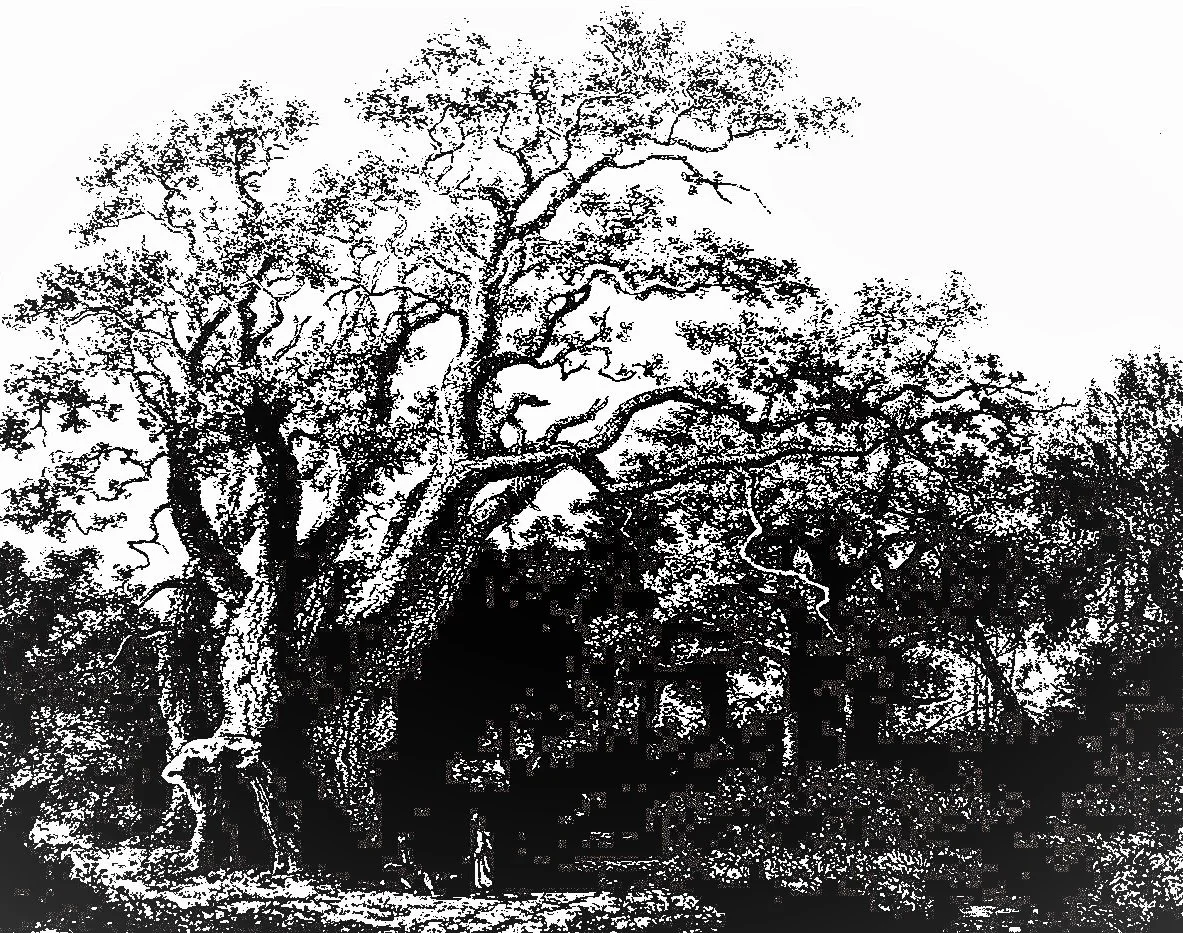
King Oak in Prior Wood