
THE VILLAGE POST OFFICE
In 1878 the cottage which was previously the Bleeding Horse alehouse, was taken over by William Bailey who moved in with his wife Jane and soon they had raised a family of four.
William built a workshop at the back for his boot and shoe making business which at first prospered, but after a few years ran into problems. His footwear gave better service than factory made products, but William could not compete on price. When he was offered to take on the new Post Office, he agreed and became Easton Royal’s first postmaster. The business stayed in the family for the next forty years.
Walter Gough was the village postman working with Mr and Mrs Bailey. After serving in the South African war, he had joined the Post Office and came to live in Easton in a cottage on Gammon Lane opposite the Green where he and his wife raised a family of two boys and a girl. Walt, as he was universally known, was a valued customer at the Bruce Arms on Saturday nights where he enjoyed a couple of pints of Wadworth’s Best Bitter.
As village postman, Walt lived an active life. Up at first light six days a week, he was normally back home in the early evening having made three return trips on his bicycle to Milton post office, delivering and collecting the morning and afternoon mail. He finished at noon on Sundays and was free until Sunday evening when he emptied the Easton post-box and took the weekend mail to Milton.
Walter worked in all weathers, he was cheerful, good humoured and liked by everyone. His was one of the best jobs in the village. He had a waterproof hat, a cape and leggings provided to keep out the rain and as long as he did his job and followed Post Office rules, he could look forward to a pension at the end of his working life.
Christmas was a particularly busy time for Walt. The volume of mail increased, there were extra deliveries, parcels arrived by the score and he had the added problem of how best to deal with the many offers of Christmas cheer from well-wishers on his rounds.
One Christmas Eve when his clients had been particularly pressing, Walt wisely decided to park his bicycle and finish off his round on foot. At the end of a very erratic delivery, realising he had an hour to spare before his next collection, Walt rested in a nearby shed where he nodded off and woke up just as dusk was falling. But he carried on and finished off his afternoon delivery just as the chapel carol singers were setting off on their midnight rounds.
A few days later, Mrs Bailey, the sub post mistress received a note from the Head Postmaster at Marlborough. An irate ‘Major’ had demanded a written explanation from Postman Gough concerning his recent deviation from postal procedure and hinted at further serious action if a reply was delayed.
Everyone was greatly worried about Walt’s future – there was even a proposal that a petition should be sent to Marlborough on Walt’s behalf. But no-one need have worried. Walt read the note with apparent amusement - he was an old soldier too – borrowed a sheet of paper, sucked at a stubby pencil and wrote:
Dear Sir,
Blame Wadworth’s. Your obedient servant, W. Gough, Postman
P.S. and a Happy New Year to all.
And that was the last anyone heard of the affair.
After William Bailey’s death in 1916, his wife continued to run the Post Office with help from her daughter Florence. Some years later, the Post Office moved to a cottage further up the village and was placed in the safe hands of Miss Reynolds. A smart new red telephone box was installed outside. When the Post Office closed for good in the late 1950’s, the box was moved up to the main road, next to the bus shelter.
Mr and Mrs Bailey with Walter Gough outside the original Post Office
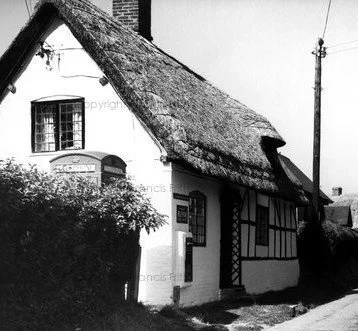
The second Post Office reproduced from a F Frith postcard
Village Green before the new road